The Ultimate Guide to AI Consulting for Small Businesses
Everything you need to know about implementing AI in your small business. From identifying automation opportunities to calculating ROI and choosing the right AI consultant.
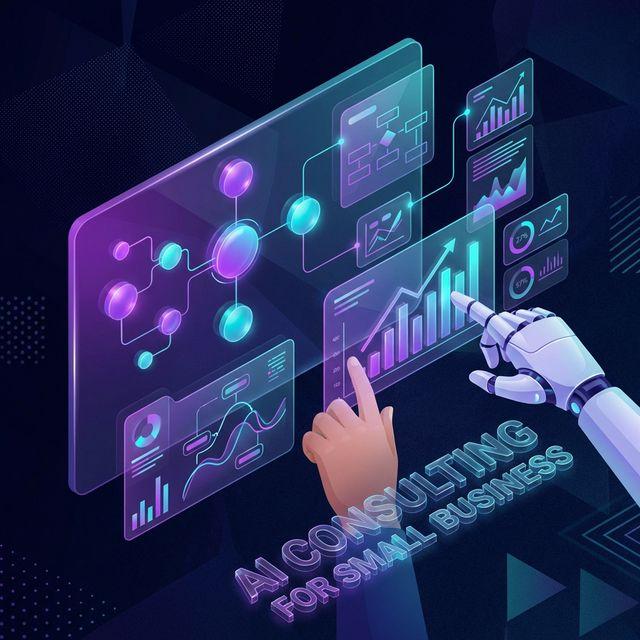
Artificial Intelligence is no longer just for enterprise tech companies with massive R&D budgets. In fact, small businesses are uniquely positioned to gain the most immediate advantages from AI implementation. Why? Because you can move faster, adapt quicker, and the impact of even minor efficiency gains on your bottom line is massive.
But where do you start? If you feel overwhelmed by the constant barrage of AI news, tools, and hype, you aren't alone.
This guide is designed specifically for small business owners and operators. We'll cut through the jargon, break down exactly what an AI consultant actually does, and give you a framework for identifying where AI belongs in your operations.
What Does an AI Consultant for Small Businesses Actually Do?
You might think an AI consultant is going to come in and build a complex machine learning model from scratch. In reality, modern AI consulting for SMBs is much more practical and results-oriented.
A strong AI consultant acts as a bridge between your specific business problems and the vast ecosystem of available AI tools. Their role typically breaks down into three core phases:
1. The Audit & Discovery Phase
Before writing a single line of code or recommending a tool, the consultant needs to understand your business. They will look for bottlenecks, repetitive tasks, and areas where data is siloed.
- The Goal: To find the low-hanging fruit where AI can deliver measurable ROI without disrupting your core operations.
2. Strategy & Architecture Development
Once the opportunities are identified, the consultant designs the solution. This isn't about recommending ChatGPT; it's about designing a workflow.
- Example: If your customer service team is overwhelmed, the strategy isn't "use an AI chatbot." The strategy is designing a system where an AI agent connects to your CRM, resolves 60% of tier-1 support tickets autonomously, and seamlessly hands off complex issues (with full context) to a human agent.
3. Implementation, Deployment & Training
This is where the building happens. The consultant orchestrates the necessary tools (using platforms like n8n or Make.com), connects APIs, and builds the custom logic. Crucially, they also train your team on how to manage and interact with these new systems.
Identifying Your First AI Opportunities
The best way to start with AI is to look at the tasks your team complains about the most. Here is a simple framework for identifying AI-ready processes:
- Is it repetitive? Data entry, invoice processing, drafting routine emails.
- Is it rules-based? If X happens, do Y. (e.g., If a lead fills out this form, route them to this salesperson and draft a follow-up email based on their industry).
- Does it rely on synthesizing text or data? Summarizing meeting notes, categorizing support tickets, identifying trends in customer feedback.
If a task meets two or more of those criteria, it is often a strong candidate for automation or augmentation.
Common Starting Points for SMBs
- Customer Support: Automated chatbots trained on your specific documentation and FAQs.
- Lead Generation & Qualification: AI agents that instantly respond to inbound leads with personalized questions to qualify them before a sales call.
- Internal Operations: Automated drafting of proposals based on CRM data, or systems that automatically extract data from PDFs and update your spreadsheets.
How to Calculate the ROI of an AI Engagement
Investing in AI consulting should never be an ambiguous expense. It should be a clear investment with a measurable return. Here is a simple formula you can use:
The Cost of the Problem:
- Hours spent per week on the task * Hourly rate of the employee(s) performing it * 52 weeks = Annual Cost.
The Estimated Savings:
- Let's assume the AI solution automates 80% of that task.
- Annual Cost * 0.80 = Estimated Annual Savings.
If the cost of the AI consulting engagement and the software subscriptions is significantly less than the Estimated Annual Savings, you have a winning project.
Important Note
Don't forget to factor in the opportunity cost. If your top salesperson saves 10 hours a week on administrative tasks, they aren't just saving their hourly wage—they are gaining 10 hours to sell more products.
How to Choose the Right AI Consulting Partner
The AI consulting market is crowded. Here is what you should look for when evaluating a partner for your small business:
- Focus on Business Outcomes, Not Just Tech: They should be asking about your revenue bottlenecks, not just trying to sell you a specific LLM integration.
- Bias Toward Pragmatic Solutions: The best consultants use existing tools and APIs to build reliable solutions quickly, rather than proposing expensive, custom-built models you don't need.
- Transparent Maintenance: AI tools change rapidly. Your consultant should have a clear plan for how the system will be maintained and updated over time.
Ready to Start Automating?
AI is not a silver bullet, but it can be a strong operational lever for many small businesses. By focusing on practical, high-ROI use cases, you can help your team spend more time on high-value work.
If you are looking for an AI partner focused on practical results for small businesses, book a strategy call.